

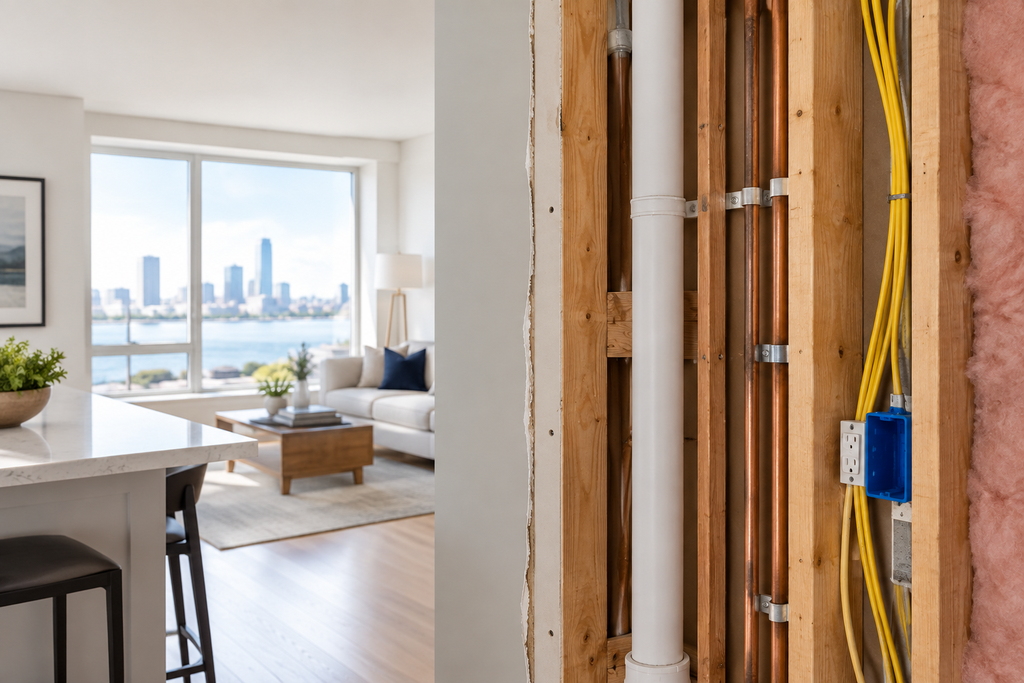
In new construction, the most important features of a home are the ones you cannot see. An agent who has been on site from foundation to final finish can speak to them with authority.
Most agents encounter a new property for the first time on listing day, after the drywall, paint and staging are complete. By that point, the structural, mechanical and building-envelope work is concealed. Agents who specialize in new construction and development, and who spend time on job sites working directly with developers and builders, give their clients a level of insight that a typical agent cannot offer.
First-hand knowledge of the build
Two finished homes can look identical in listing photos and still differ significantly in quality.
Professionals who are present at each stage of construction have direct knowledge of:
- Foundation and framing
- Insulation and air sealing
- Plumbing, electrical and HVAC installation before walls are closed
- Windows, waterproofing and roofing
- The standard of the finish work
When a client asks what is behind a wall, these agents answer from direct observation rather than the
builder’s summary.
Industry data shows why this matters. According to the National Association of Home Builders’ 2024 Construction Cost Survey, site work, foundations, framing and major systems rough-ins account for 53.9% of a new home’s construction cost. Nearly all of that work is hidden once the walls are closed. Interior finishes, the part buyers see first, account for 24.1%.
What it means for buyers
Clear answers on construction quality. An experienced new-construction agent can explain how a home was built in plain terms, from its mechanical systems to the durability of its materials, so you understand exactly what you are purchasing.
A complete picture at every showing. An agent who followed the project from the ground up can walk you through how the home came together and why specific decisions were made, well beyond a tour of the finishes.
Guidance on new-construction terms. Builder contracts, warranties, punch lists and closing timelines differ from a standard resale. Knowing what to review and which questions to raise protects your interests.
Confidence in the price. A knowledgeable agent can explain how a home’s price was reached, allowing you to compare properties fairly. A lower price elsewhere may reflect lesser materials or shortcuts that are not visible at a showing.
What it means for sellers
Construction quality that is properly represented. Quality workmanship rarely comes through in photographs. Making sure buyers and their agents understand it supports your asking price.
A compelling story at showings. Explaining how your home was built and the reasoning behind key choices gives buyers a clear reason to choose your property.
A price you can stand behind. Your pricing is presented and defended to buyers and their agents, supported by the details of the build.
What it means for developers
Zoning and feasibility expertise. A working knowledge of zoning, unit mix and what a site can support helps you evaluate a property’s potential and plan a project the market will absorb.
Marketing that begins during construction. Documenting and sharing the project’s progress as it is built
generates buyer interest well before completion.
Pricing aligned with your costs. An understanding of what goes into a project helps set pricing that
protects your margin while keeping units moving.
Understanding the listing price
A new-construction price is more than a comparison to recent sales. It reflects land acquisition,
permitting, materials, labor, site work, building systems and finish quality. Agents who follow projects
from start to finish can explain clearly where the value comes from.
Here is how the price of the average new single-family home breaks down nationally, according to
NAHB’s most recent survey:
| Component | Share of sales price |
| Construction | 64.4% |
| Finished lot | 13.7% |
| Builder profit | 11.0% |
| Overhead and general expenses | 5.7% |
| Sales commission | 2.8% |
| Financing | 1.5% |
| Marketing | 0.8% |
Regulation adds to that cost as well. A June 2026 NAHB study found that regulations make up 26.4% of the average new home’s price, and that regulatory costs have risen more than 40% since 2021. Land, labor and permitting costs in Greater Boston typically run above national averages, which makes understanding the build even more important locally.
That transparency serves everyone involved: buyers understand what they are paying for, sellers can
stand behind their price, and developers can set pricing that reflects their investment.
The bottom line
Any agent can point out quartz countertops and new flooring. Understanding what lies behind them is what protects your investment. Whether you are purchasing new construction, selling a completed project or planning a development, working with an agent who knows the build makes a measurable difference.
Reach out at any time to discuss your goals.
Our team manages every step, from your first tour through closing.
Contact us to walk through any of the three residences.
Mark, Ciampa Group
(978) 382-8582 | mark@ciampagroup.com | ciampagroup.com
Sources
- Cost of Constructing a Home in 2024, National Association of Home Builders, January 2025
- Regulatory Costs Jump 40% in Five Years, Add $131,734 to New Home Prices, National Association of Home Builders, June 2026